Summary
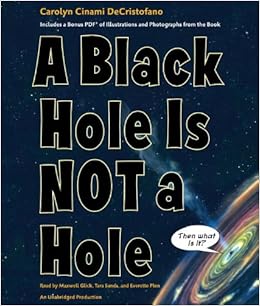
The book A Black Hole is Not a Hole by Carolyn Cinami DeCristofano is a non-fiction informational book on none other than black holes as is denoted in the title of the book. Black holes are usually thought of as holes, but this book aims to educate the reader by examining what they really are. The book is organized into eight chapters. The first chapter talks about the pull a black hole has and compares it to a whirlpool where the pull gets stronger as you get closer to it. The second chapter is on gravity and the role it plays in that pull of a black hole. The third chapter is on the origin of black holes from collapsed stars and the fourth chapter is on why black holes are black and speaks on the science behind the travel of light. The fifth chapter is on the history of the discovery of black holes and the sixth chapter is on role of radio waves in discovering black holes that are not observable. Chapter seven takes the reader through what would happen if they went through a black hole and chapter eight closes with a discussion of Einstein's theory of relativity and its relation to black hole science.
Reference
DeCristofano, C. C., & Carroll, M. W. (2012). A black hole is not a hole. Watertown, MA: Charlesbridge.
Impressions
I found this book to be a very entertaining way to explain the science behind black holes. The illustrations and pictures are very captivating and the style of writing is very informal and entertaining. This book would be great for a reluctant reader of non-fiction. The scientific concepts were explained using everyday examples that an elementary student could understand and there is also a glossary in the back of the book to explain any terms that may provide some challenge to the reader.
Professional Review
Seidman, C. (2012). A black hole is not a hole. Science Scope, 36(2), 94-96. Retrieved from https://libproxy.library.unt.edu/login?url=http://search.proquest.com/docview/1093883106?accountid=7113
Library Uses
This book could be used in a STEM program about black holes for kids and could be used as a reference for a STEM activity. One activity could be making a whirlpool in a bucket to experience gravitational pull.

No comments:
Post a Comment