Sunday, November 27, 2016

Module 13: Amulet Book 1: The Stonekeeper


Summary

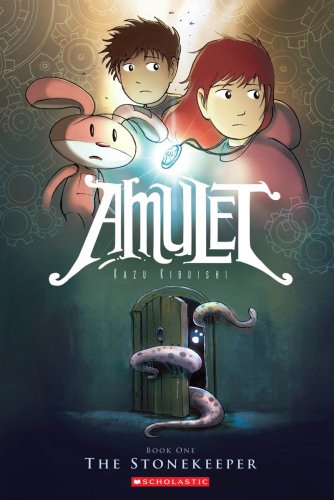
The Stonekeeper is the first book of the Amulet graphic novel series by Kazu Kibuishi. The book begins with a prologue where Emily, Navin and their parents are on the road and they end up getting into an accident where their father dies. Then in the first chapter, Emily, Navin and their mother move to their old ancestral house away from the city because they cannot afford to live there anymore. In the attic, Emily finds many of her great grandfather's belongings and finds a mysterious amulet. They discover that this amulet has mystical powers and can speak to Emily. One night, they hear noises coming from the basement and their mother goes to investigate and gets eaten by some sort of creature who goes into a hidden room in the basement. Emily and Navin search for their mother and find that the hidden room goes further into a mysterious land full of odd creatures. 

They find the monster who ate their mother and find that their mother is still alive in the belly of the beast. They try to get her out of there, but the creature is persistent and gets away. They end up being rescued by a mysterious figure who leads them to a house and there they find their great grandfather who explains to them that the amulet has great powers, and he dies. The house is also full of odd robots that their great grandfather built. They all help Emily and Navin to rescue their mother and they have a machine that can locate their mother. They go and try to rescue her, but their attempt fails and they encounter another mysterious figure who wants the amulet. Emily finds the inner strength to summon the amulet's power to fight off this mysterious figure, and at the same time are able to rescue their mother who is poisoned from being in the belly of the beast for so long. This is where the book ends.


Reference

 Kibuishi, K. (2008). Amulet: The Stonekeeper. New York, NY: Graphix.
Impressions

This book is very fast-paced and action packed. There is not one dull moment as there is always something exciting happening. The pace of the book might be too fast for some, but I found it to be a very entertaining pace. I also really enjoyed the style of illustrations and artwork. The colors felt very vivid and the emotions of the characters really came through in their faces. The monsters are also very well drawn.

Professional Review

Spisak, A. (2008). The stonekeeper. Bulletin of the Center for Children's Books, 61(8), 338. Retrieved from https://libproxy.library.unt.edu/login?url=http://search.proquest.com/docview/223708968?accountid=7113

Library Uses

This would be a good book for a Manga club for discussion.

Sunday, November 20, 2016

Module 12: Nelson Mandela


Summary
In this picture book biography entitled, Nelson Mandela, by Kadir Nelson, we get a glimpse into the life of Nelson Mandela and his struggles for racial justice and equality in apartheid South Africa. The book begins with a young Rolihlahla playing in the fields of South Africa, but when Rolihlahla goes to school, his teacher would not say his real name and ended up calling him Nelson instead. Nelson continued his education and eventually became a lawyer who defended the rights of poor and powerless. Eventually, the South African government instituted a policy of segregation called apartheid. Nelson organized and fought back against this unjust policy which landed Nelson in jail for decades while doing hard labor while in prison. As time passed, the government changed, apartheid ended and nelson was set free after twenty-seven years in prison. He was then elected president of South Africa. At the end of the book, the author gives a summary of Nelson Mandela's life.

Reference

 Nelson, K., & Rago, M. (2013). Nelson Mandela. New York, NY: Katherine Tegen Books. 

Impressions

The book provides a very brief look at the struggles and life of Nelson Mandela from when he was a child until he became president of South Africa. The illustrations are very large and take up both pages which provides for a very intimate feel with story. I would have liked if the book gave a bit more information on his presidency and his death since the book was published well after his death in 2013. For the pacing of the book, it probably made sense to end the book right when he is elected president as it ends on a high and positive note, but as a reader, I was thinking, "What happens next?" It reminds me of how the struggle for social, economic, and racial justice does not end with the election of an official to office, but it requires sustained awareness, organization, and resistance to all forms of oppression and inequality. After an election, it is easy to relax and forget about the issues and challenges that still continue to plague our society, but in this book, Nelson Mandela did not give up his fight after the government decided to enact apartheid, which signals to the reader that the struggle continues as long as there are oppressed and exploited people in the world.


Professional Review

Bush, E. (2013). Nelson Mandela by Kadir Nelson (review). Bulletin of the Center for Children's Books 66(7), 347-348. The Johns Hopkins University Press. Retrieved December 8, 2016, from Project MUSE database.

Library Uses

This book could be used for a display of those who fought for social and racial justice around the globe. 

Sunday, November 13, 2016

Module 11: A Black Hole is Not a Hole


Summary

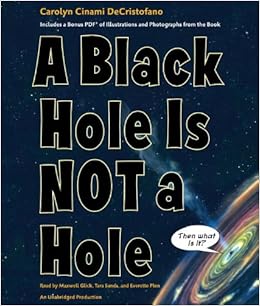
The book A Black Hole is Not a Hole by Carolyn Cinami DeCristofano is a non-fiction informational book on none other than black holes as is denoted in the title of the book. Black holes are usually thought of as holes, but this book aims to educate the reader by examining what they really are. The book is organized into eight chapters. The first chapter talks about the pull a black hole has and compares it to a whirlpool where the pull gets stronger as you get closer to it. The second chapter is on gravity and the role it plays in that pull of a black hole. The third chapter is on the origin of black holes from collapsed stars and the fourth chapter is on why black holes are black and speaks on the science behind the travel of light. The fifth chapter is on the history of the discovery of black holes and the sixth chapter is on role of radio waves in discovering black holes that are not observable. Chapter seven takes the reader through what would happen if they went through a black hole and chapter eight closes with a discussion of Einstein's theory of relativity and its relation to black hole science. 

Reference

DeCristofano, C. C., & Carroll, M. W. (2012). A black hole is not a hole. Watertown, MA: Charlesbridge.

Impressions

I found this book to be a very entertaining way to explain the science behind black holes. The illustrations and pictures are very captivating and the style of writing is very informal and entertaining. This book would be great for a reluctant reader of non-fiction. The scientific concepts were explained using everyday examples that an elementary student could understand and there is also a glossary in the back of the book to explain any terms that may provide some challenge to the reader. 

Professional Review

Seidman, C. (2012). A black hole is not a hole. Science Scope, 36(2), 94-96. Retrieved from https://libproxy.library.unt.edu/login?url=http://search.proquest.com/docview/1093883106?accountid=7113

Library Uses

This book could be used in a STEM program about black holes for kids and could be used as a reference for a STEM activity. One activity could be making a whirlpool in a bucket to experience gravitational pull.

Sunday, November 6, 2016

Module 10: Freedom Summer


Summary

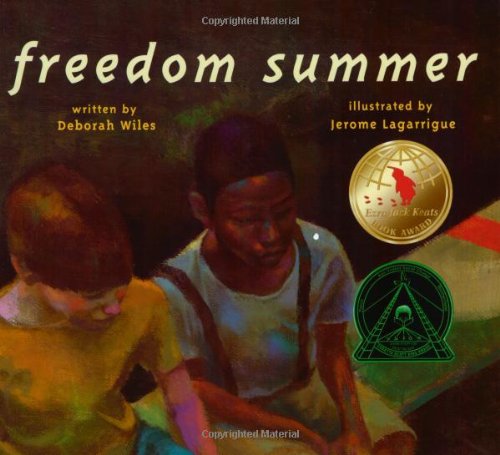
In the book, Freedom Summer by Deborah Wiles and illustrated by Jerome Lagarrigue, two kids who were best friends in the early 1960s find out the world isn't as simple to let two boys be friends and share experiences together in the age of open racism and segregation. The two boys, John Henry who is black and who is white, enjoy their summer by sharing there time together with fun activities that include swimming and eating ice cream. However, it is these two simple activities that bring them to discover the cruel reality of segregation and racism. When the boys go to an ice cream shop, the John Henry must enter though a back door while Joe gets to go through the front door. Then when segregation legally ends, they both decide to go swimming at the pool, but when they get to the pool they find that it has closed down because the owners do not want black people to swim in the pool with white people. However, they find that they can go into the grocery store together in the same entrance. 

Reference

 Wiles, D., & Lagarrigue, J. (2001). Freedom Summer. New York: Atheneum Books for Young Readers.

Impressions

This book really encaptures the innocence of children and how racism is not inherent in human nature, but taught. The book begins with all the fun the two boys have with each other and it makes the common human element very apparent, but when the boys find disappointment in not being able to share a simple activity such as swimming, it really shows how racism and segregation is based on ignorance. The two boys seem to be caught in the wave of the times, which I think many people can relate in this present day. Near the end of the book, John Henry becomes aware of the reasons for segregation and deeply wishes to be treated like an equal human being, which I think does a good job of showing the way to fight for social and racial justice is through awareness that can change the mass consciousness for society for the better.

Professional Review

Children's Book Review: Freedom Summer by Deborah Wiles, Author, Jerome Lagarrigue, Illustrator Atheneum Books $18.99 (32p) ISBN 978-0-689-83016-7. Retrieved October 30, 2016, from http://www.publishersweekly.com/978-0-689-83016-7 

Library Uses

This book could be used in an inclusive storytime that promotes friendship and a way to address some of the issues that have stood in the way of social and racial justice.