Sunday, September 25, 2016

Module 4: A Wrinkle In Time


Book Summary

A Wrinkle in Time is a science fiction story that tests the limitations of time and space. The story begins with the main character Meg dealing with the fallout from the disappearance of her father, who many believe he ran away with another woman leaving his family behind, which consists of Meg's younger brother Charles Wallace who is a very intellegent boy, two twin brothers, and Meg's mother. The family receives a visit from a mysterious woman called Mrs. Whatsit and she mentions a tesseract, which Meg's mother recognizes as something related to her missing husband. Meg and Charles Wallace run into Calvin, a jock at Meg's school and they all run into Mrs. Whatsit again who explains to the three kids that the universe is threatened by an evil entity called the "Darkness" and that her father is still alive, but held captive by the Darkness.

This is where the science fiction comes in with Mrs. Whatsit's ability to bend time and space to transport any time and any where she pleases, so she transports the three children to a planet called Camazotz, which is under control of the Darkness. On this planet, the three children find the central control of the Darkness called IT and Charles Wallace believes he can fight the Darkness with his intelligence, since the IT controls other beings through implanting negative thoughts in their minds. Unfortunately, the IT wins over Charles Wallace, but Meg and Calvin find Meg's father and they all are able to escape with Meg's father's ability to tesseract and transport somewhere else. 

Meg volunteers to go back to Camazotz to try and save Charles Wallace. IT also tries to control Meg with negative thoughts, but Meg discovers that IT's weakness is love. By reminding Charles Wallace of how much she loves him, she is able to break him free from the spell IT had on him and they are able to tesserect and escape. At the end, the whole family is back together on earth only five minutes since they all left because Mrs. Whatsit chose that time for them to return and reunite. 

Reference

 L'Engle, M. (1962). A wrinkle in time. New York: Square Fish.

Impressions

This was a very exciting book for me primarily because I am personally interested in the science fiction genre and the concept of controlling time and space. Throughout the story, L'engle puts in scientific facts that bring a sense of reality to the story and the ability to tesseract. With the scientific backing, it seems that tesseracting could be possible with the progression of science, and it really gives the reader a feeling that there is so much more to the universe than our current knowledge of it. The ability to see and experience different worlds in our vast universe can draw in any reader interested in science fiction. After reading this book, it has made me want to read the rest of the series. 

Professional Review

Paul, P. (2012, January 28). ‘A Wrinkle in Time’ and Its Sci-Fi Heroine. Retrieved September 18, 2016, from http://www.nytimes.com/2012/01/29/books/review/a-wrinkle-in-time-and-its-sci-fi-heroine.html

Library Uses 

A good use for this book would be a bookclub for tweens that is based on STEM. STEM is a hot topic these days in libraries and in schools, and even though this book is science fiction, the book still has some interesting science facts in it. 

Sunday, September 18, 2016

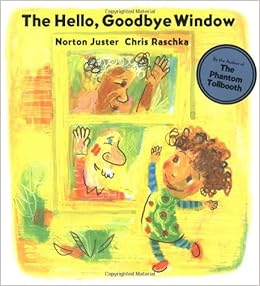
Module 3: The Hello, Goodbye Window


Book Summary

In The Hello, Goodbye Window by Norton Juster and Chris Raschka, a little girl visits her grandparents and the focus of the story is a window in her grandparents' house. The visit begins with the girl seeing her grandparents through the window and saying hello to them. Then the girl describes all of the activities and fun she has with her grandparents. She describes things they did in the kitchen together, her grandfather playing the harmonica, and how she spends the night at their house. In the morning they all eat breakfast together and she plays outside while her grandparents do some gardening. Then the girl sits by the window, which her grandmother tells her is a magic window because "anybody can come along when you least expect it." At the end, her parents pick her up and they stop at the window to say one last goodbye to her grandparents. 

Reference

Juster, N., & Raschka, C. (2005). The hello, goodbye window. New York: Michael di Capua Books/Hyperion Books for Children. 

Impressions

The way the girl recalls her visit with her grandparents and the style of illustrations makes me think that this book is really an adult remembering the good memories she had with her grandparents as a child. The illustrations are very dreamlike and hazy much like as if one was remembering something years ago, but they do capture the feeling of the moments that are described by the little girl. The illustrations give a warm feeling of good times with grandma and grandpa, and the story also is more of a recollection of those feelings. In regards to the special window, the story and illustrations convey a bittersweet feeling of saying hello and the eventual goodbye to loved family members. At the end of the story, the little girl thinks of having a special "hello, goodbye window" too at her house when she grows up and it really conveys to me how time passes and the next generation eventually becomes the old generation. 

Professional Review

Larkin, E. (2010, February 04). The Hello, Goodbye Window by Norton Juster, illustrated by Chris Raschka. Journal of Intergenerational Relationships, 8(1), 98-98. doi:10.1080/15350770903523753 

Library Uses

This book could be used during Grandparents appreciation day at the library with a special storytime for children and their grandparents or whoever is the equivalent in their lives. This book could be used to prompt a conversation for the children in asking them what they love doing with their grandparents.

Sunday, September 11, 2016

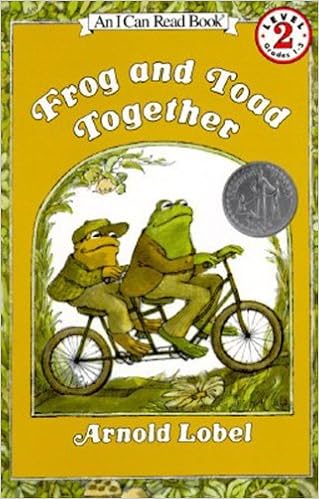
Module 2: Frog and Toad Together


Summary

Frog and Toad Together by Arnold Lobel is a collection of five short stories that are each a chapter where the two main charcaters, Frog and Toad, are best friends and the short stories are about there time together. Each of the chapters can stand alone as it's own story and can be read out of order. 

The story is called "The List." In this story, Toad makes a list of everything he has to do and crosses out each list item that he completes. He goes to visit Frog and Toad ends up losing the list and it stops him from doing anything else, so they just sit together the whole day until it gets dark and Toad remembers the last thing on his list was to go to sleep and they fall asleep together. 

The second story is called "The Garden," where Toad visits frog while Frog is gardening. This inspires Toad to plant some seeds, but they don't sprout as soon as Toad would like, so he does things like sings and reads to the seeds. He ends up falling asleep and when he wakes up he finds that the seeds have sprouted, so he believes that all the work that he did in singing and reading to the seeds helped them sprout.

The third story is called "Cookies," and in this story, Frog and Toad are eating cookies and have to excersies restraint and self-control to keep themselves from eating all the cookies. To do this, they hide the cookies in various places, but they end up getting the cookies out. Finally, they give the cookies away to some birds.

The fourth story is called "Dragon and Giants," where Frog and Toad read a book about brave people fighting dragons and giants. They decide to test their bravery by going outside to face various challenges and other animals. After surviving a snake, landslide, and a hawk, they go back home together and appreciate the bravery of each other while hiding underneath the covers and in the closet.

The last story is called "The Dream" and Toad dreams that he was performing on stage with Frog as his audience, but Frog gets smaller and smaller with each act until he disappears. Toad gets worried and he wakes up to find Frog with him and this makes Toad appreciate their friendship.

Reference

 Lobel, A. (1972). Frog and toad together. New York: Harper & Row. 

Impressions

When reading Frog and Toad Together, it reminded of how important friendship and compainionship can be in our lives. In many of the stories, Toad has a tendency to become self-absorbed and Frog does caring things for Toad and this reminds him of what is really important, which is the friendship and the companionship that they share together. In the first story called "The List," I felt like I could really relate to Toad when he makes this long list of what needs to be done in the day. It reminded me of the times where I put so much priority on getting things done in the day that it would stress me out and I would get flustered to where I felt overwhelmed. When Toad loses his list, he becomes so overwhelmed that he ends up just sitting there, when the whole time, he had Frog by his side helping him and supporting him. This is book is a great way to remind or show readers that kindness and friendship are one of the most important things in life.

Professional Review

Bird, E. (2012, June 15). Top 100 Picture Books #15: Frog and Toad Are Friends by Arnold Lobel. Retrieved September 11, 2016, from http://blogs.slj.com/afuse8production/2012/06/15/top-100-picture-books-15-frog-and-toad-are-friends-by-arnold-lobel/ 

Library Uses

Since the Frog and Toad series are such popular classics, a public library could do a larger scale event based on the series that could include Frog and Toad decorations, a game, a craft, and reading one of the stories from this book.

Sunday, September 4, 2016

Module 1: Miss Brooks Story Nook


Summary

In Miss Brooks' Story Nook by Barbara Bottner, the story is about a girl named Missy who is very excited about a storytime called Story Nook with her teacher Miss Brooks. As she goes to school, she is usually harassed by a neighborhood bully who steals her hat, so she usually takes a long way to school to avoid the bully. This time, she is running late because it was raining and she has to take the route where she is harassed by the bully. Missy finally makes it to the story nook and as the story was about to begin, the lights went out because of the storm. Miss Brooks then asks all the children to tell a story and each of the children come up with a story about things that they liked. Missy then came up with a story that about something that could scare the bully and she came up with a snake that handled her problem with the bully. In the process, Missy learns from Miss Brooks about the elements that make a good story. This story gives Missy the courage to deal with the bully by telling him she has a snake but it really is just her scarf, and she ends up with a happy ending.

Reference

Bottner, B., & Emberley, M. (2014). Miss Brooks' Story Nook. New York, NY: Alfred A. Knopf.

Impressions

This book does a good job of explaining what makes a good and entertaining story through Missy's attempt to tell a story. While she is trying to tell the story, Miss Brooks does a good job of giving Missy encouragement to continue to develop the story until Missy has a complete story. It is also nice that the book encourages those who are trying to develop a story that a story can be about anything and it really has to do with one's own personal tastes and experiences. Missy is dealing with a bully in her life so naturally she decides to make a story about a bully. I was a bit shocked to see that Missy came up with a story where a snake squeezes the bully so hard his eyeballs pop out. The illustrations make the action seem cute and funny, but when I think about it, it seems quite violent to wish that fate one someone. Other than this, the book is entertaining and enjoyable.

Professional Review

Phelan, C. (2014, July 1). Miss Brooks' Story Nook (Where Tales Are Told and Ogres Are Welcome). Booklist110(21), 87. Retrieved from https://libproxy.library.unt.edu:5154/login?url=http://libproxy.library.unt.edu:2143/ps/i.do?p=LitRC&sw=w&u=txshracd2679&v=2.1&it=r&id=GALE%7CA376932811&asid=d5838ba064d42b1ef861008b754fb45f

Library Uses

One library use for this would be for a storytelling workshop where kids can tell stories instead of listen to stories. This book would be a great tool to use to teach the different elements of a good story.