Sunday, October 23, 2016

Module 8: The Dead and the Gone


Summary

The Dead and the Gone by Susan Beth Pfeffer is the second book of The Last Survivors series, but can be read as a stand-alone book as the events in this book happen congruently with the events of the first book. In The Dead and the Gone, an asteroid hits the moon which causes the moon to shift its orbit dangerously close to the earth which triggers a variety of continuous natural disasters from floods, tsunamis, volcanic eruptions, continuous ash in the air and food shortages. 

The book follows the ordeals of the children of the Morales family in New York where the oldest son Alex must take care of his two younger sisters after his parents never return home and are presumed dead. Throughout the slow decay and destruction of society, normal everyday life becomes harder as normal institutions such as their private Catholic schools stay open after the initial disasters, but eventually close down as well. Alex is forced with tough decisions and forced to do things like steal from dead bodies in the street to keep his sisters alive by bartering with those things that he finds. Slowly, the population of New York either dies off or finds a way to leave and at the end of the book, they also find a way to leave. 

Reference

 Pfeffer, S. B. (2008). The dead & the gone. Orlando, FL: Harcourt.

Impressions

Being a fan of apocalyptic survival stories, I really enjoyed The Dead and the Gone. I found it very interesting that the disasters in this book didn't cause an immediate destruction of society, but the book builds a picture of a society that falls apart slowly, yet fast enough to cause a sense of distress and worry. In the beginning, I found it odd that school would continue to operate, but then I felt that people would try to continue in the face of impending doom to the best of their abilities. Another thing I enjoyed about the book was that it brought into play the fact that those with money, resources and connections were able to fair better in this new and terrible world, while those who were poor still struggled as in the world before the disasters. As the book continues, the worth of money slowly decreased as a bartering system began to take it's place. Overall, I enjoyed this book and it really made me feel like I should prepare with some emergency supplies. 
Professional Review

Spisak, A. (2008). The Dead and the Gone (review). Bulletin of the Center for Children's Books 61(11), 489. The Johns Hopkins University Press. Retrieved December 8, 2016, from Project MUSE database.

Library Uses

This book could be used for a prepper program at the library. The program can focus on emergency supplies for natural disasters and the library could share resources in the community as well as survival techniques. 

Sunday, October 16, 2016

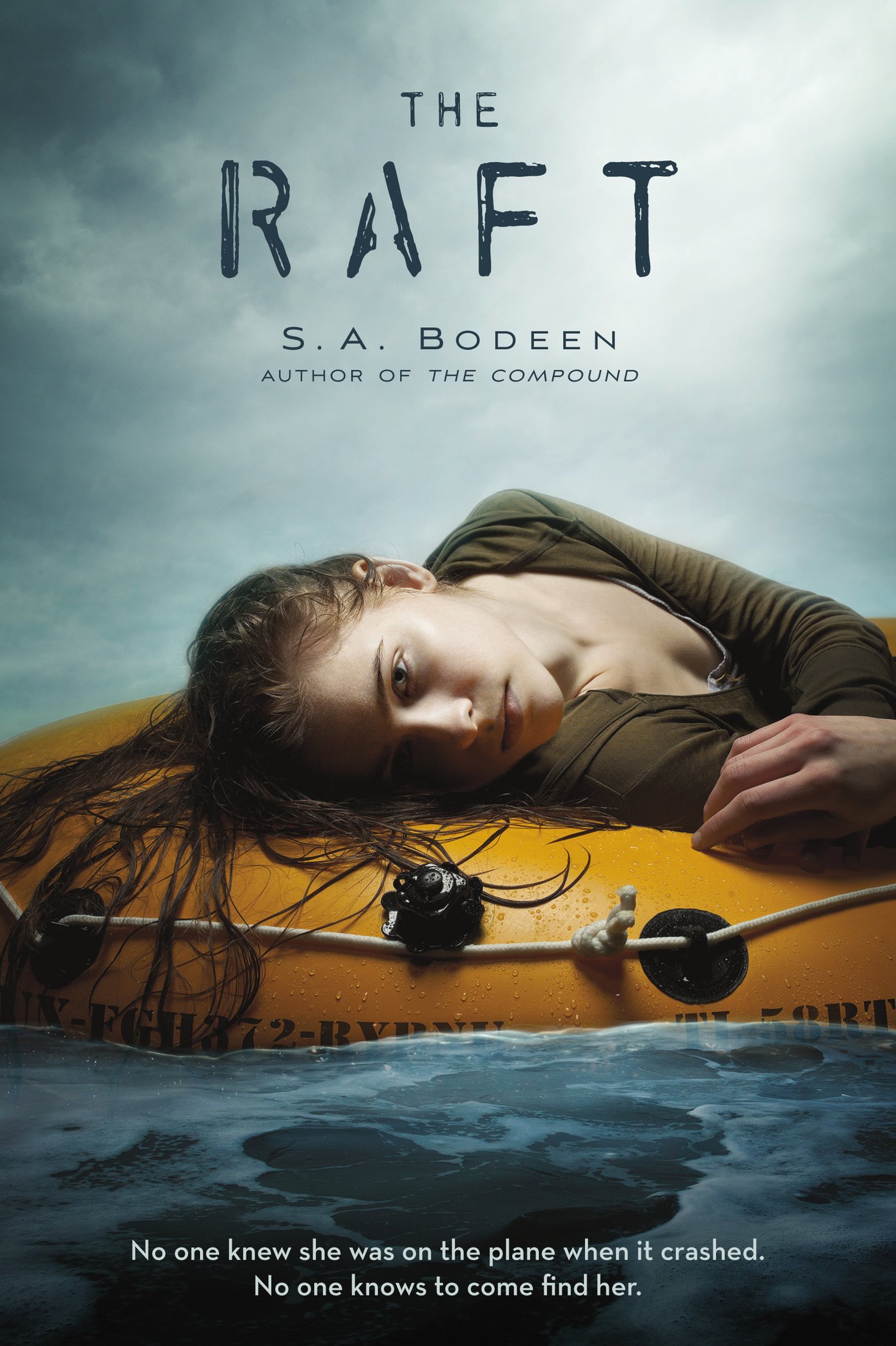
Module 7: The Raft


Summary

The Raft by S. A. Bodeen is a survival story set in the pacific ocean somewhere in between Hawaii and Midway Island. The main character of the story is a teen girl named Robie who is vacationing on Hawaii at her aunt's house. Her aunt has an unexpected business trip to the mainland and Robie convinces her to let her stay at her house while she is on the business trip. Robie's aunt agrees on the condition that her friend visits her everyday to check on her. However, once Robie's aunt leaves, the friend is unable to check on her, which leaves Robie all by herself for an entire week. 

On the first night alone, Robie decides to go get something to eat and ends up being harassed by a strange man. She runs all the way to her aunt's house and realizes that she's not fit to stay by herself, so she decides to catch a cargo flight to Midway back to her parents. Robie is able to hitch a ride on a cargo plane to Midway, but the pilots and airport staff forget to weigh her and put her on the manifest. On the way to Midway, the plane loses one engine to a storm and ends up crashing in the middle of the Pacific ocean. One of the co-pilots, Max, saves Robie by pushing her out of the plane with a raft and both end up on the raft.

Once on the raft, Robie and Max face many obstacles and challenges to survive for several days on a raft, when they finally come upon an uninhabited island. For the whole time on the raft, Max is drifting in and out of consciousness and when they finally come on to the island, it is revealed that Robie actually killed Max when she put him outside of the raft when there was too much weight on the raft, and she was actually imagining him to be alive the whole time because she was too scared to survive on her own. Eventually, Robie is rescued by a research team who go to the island on a boat and they take her back to Midway. 

Reference

 Bodeen, S. A. (2012). The raft. New York: Feiwel and Friends. 

Impressions

Being a fan of survival stories, I really enjoyed this book because it was very interesting to see how Robie coped with her situation and how she changed because of her experiences. In the beginning of the book, Robie is portrayed as a teen who worries about what normal teens are worrying about, but when she is put in a survival situation, she realizes how much she took for granted in the regular world, but she also realizes a strength she never knew she had. These two elements of the story are why I like survival stories. First, it reminds me of how much I take for granted everyday and reading stories like this one remind me to appreciate what I have. Second, I am usually afraid to step out of my comfort zone, but when one is put into a survival situation, one must go beyond self-imposed limitations and that is exactly what Robie does. Some of the things Robie does like killing Max to save herself is a bit shocking to me, but she does what it takes to survive. 

Professional Review

Bush, E. (2012). The raft. Bulletin of the Center for Children's Books, 66(2), 73. Retrieved from https://libproxy.library.unt.edu/login?url=http://search.proquest.com/docview/1313181660?accountid=7113

Library Uses

This book could be used as a conversation starter in a workshop on outdoor survival for teens and adults. Even though the story takes place on a raft and a uninhabited island, some of the story can assist in teaching what to do and what not to do in a survival situation.

Sunday, October 9, 2016

Module 6: This is Not My Hat


Summary

This is Not my Hat is a simple story of a fish who stole a hat from a bigger fish. This smaller fish takes the hat while the bigger fish is sleeping. The bigger fish eventually wakes up and notices his hat is missing. The small fish thinks he got away without the bigger fish noticing because he goes into an area with a lot of seaweed, but a crab sees him go in there. The bigger fish comes around and the crab points to where the small fish went. The small fish is so proud he got away in what he thinks is a good hiding spot, but the bigger fish follows him into the seaweed and then the big fish comes out with his hat on his head and the smaller fish is nowhere to be seen. 

Reference

 Klassen, J. (2012). This is not my hat. Somerville, MA: Candlewick Press. 

Impressions

This is a very short and simple story with the illustrations being the most appealing part of the book. The illustrations are also very simple, but they convey a lot of emotions through the eyes of the characters in the book. As for the story, it's a good story to show the negative side of stealing, but on the other hand, I always get a little apprehensive when one character eats another character in a children's picture book. While it doesn't show the small fish getting eaten, it is implied when the little fish doesn't come back out of the seaweed area.  

Professional Review

Hulick, J. (2012). This Is Not My Hat (review). Bulletin of the Center for Children's Books 66(3), 129-130. The Johns Hopkins University Press. Retrieved October 30, 2016, from Project MUSE database.

Library Uses

This book would be good for an art class or workshop where kids can cut out shapes of fish or anything that they like and put it against black construction paper. The art style of the book is very simplistic and could possibly be imitated.

Sunday, October 2, 2016

Module 5: When the Beat was Born


Summary

When the Beat was Born is a picture book biography of DJ Kool Herc and his role in the creation of DJ-ing, breakdancing and hip-hop. DJ Kool Herc began as Clive, a kid who loved music and rhythm and grew up in Jamaica idolizing the Jamaican DJs and the parties they had. This made him want to become a DJ. Clive then moved to New York City when he was thirteen and became known as "cool as Clyde" for his basketball talent and "Hercules" because of his large size, and he then combined the two names and called himself "Kool Herc."

Kool Herc then used his father's sound system to throw a dance party and he then became known as DJ Kool Herc. At these parties, he noticed people dancing very hard to the breaks in the song and he would then loop the breaks so they could dance longer. It was here that break-dancing was born. Also during the breaks in the song, he would call out the name of his friends in little raps and so rapping and the MC was born. These parties became so large that people from all over would go to these parties and that was where some of the other big names in early hip-hop got started, which then started hip-hop on the path to becoming mainstream. 

Reference

 Hill, L. C., & Taylor, T., III. (2013). When the beat was born: DJ Kool Herc and the creation of hip hop. New York: Roaring Brook Press. 

Impressions

This book is a great introduction to the origins of hip-hop and the elements of hip hop: breaking, DJ-ing, and MC-ing (rapping). It is quite an inspirational story to hear that hip-hop all started with a kid who loved music and used the tools he had around, which were turntables and speakers. From there, a movement of community and music was born with people coming together for self-expression. The illustrations are also well-done in that they give a glimpse of what it was like back when DJ Kool Herc was younger. At the end of the book there is a timeline of important milestones in hip-hop history and it was nice to see when these things happened in relation to each other. 

Professional Review

Bush, E. (2013). When the Beat Was Born: DJ Kool Herc and the Creation of Hip Hop by Laban Carrick Hill (review). Bulletin of the Center for Children's Books 67(2), 95. The Johns Hopkins University Press. Retrieved October 2, 2016, from Project MUSE database.

Library Uses

When I was working at the Chino Hills Branch Library of the San Bernardino County Library system, I started a weekly open breakdance/DJ session for the teens in the community that were into Hip-Hop dance and music. This book would have been good to use as an introduction to the origins of Hip-Hop breakdancing and DJ-ing.